 how-to
Are Natural Daily Vitamins Worth Taking?
Last Updated: October 28, 2026
Quick Summary
Natural daily vitamins are supplements made with nutrients from food sources, and they work best as a backup for an already mostly good diet rather than a replacement for real food. Most healthy adults do not need them to prevent heart disease, cancer, or memory loss, but a daily multivitamin can close small gaps in a busy diet.
- A daily multivitamin may slow global cognitive aging by about two years in older adults, per the COSMOS trial.
- In the United States, natural is not a regulated health claim on a supplement label; it is a marketing term.
- Look for USP, NSF, or ConsumerLab seals, which mean the product was tested for identity, potency, and contaminants.
- Fat-soluble vitamins A, D, E, and K build up in the body and can reach toxic levels at high doses.
- Vegans and vegetarians should prioritize B12, iron, and omega-3s in their daily vitamin choice.
Table of Contents
- Do You Actually Need Natural Daily Vitamins?
- The Benefits of Taking Multivitamin Supplements, Backed by Research
- Natural vs Synthetic Vitamins: Does the Source Matter?
- How to Choose a Multivitamin That Fits Your Life
- Daily Vitamin Safety and Side Effects You Should Know
- Matching Natural Daily Vitamins to Your Age, Diet, and Health Status
- Building Your Daily Vitamin Routine with Fresh Earth Wellness
- Frequently Asked Questions
Do You Actually Need Natural Daily Vitamins?
Most healthy adults do not need natural daily vitamins to prevent heart disease, cancer, or memory loss. But a daily multivitamin can still close small gaps in a busy diet.
Natural daily vitamins are supplements made with nutrients from food sources, and they work best as a backup for a diet that is already mostly good, not a replacement for real food or a cure for poor eating habits.
Filling Nutritional Gaps Without Replacing Food
A nutritional gap is a shortfall in vitamins or minerals your body needs daily. Skipped breakfasts, low vegetable intake, and restricted diets create gaps quietly.
The FDA's guidance on dietary supplements frames supplements as a way to help people meet daily nutrient needs, not as a substitute for food.
Where supplements do earn their place:
- Folic acid lowers the risk of certain birth defects, per the NIH Office of Dietary Supplements
- Calcium and vitamin D support bone strength and slow bone loss
- Vitamin B12 matters for vegans and older adults who absorb it poorly
Notice what is missing: "feeling tired" and "general wellness", the reasons most bottles get bought.
The Benefits of Taking Multivitamin Supplements, Backed by Research
The strongest evidence for multivitamins is narrow: a daily multivitamin may support memory in older adults, but it does not appear to prevent heart disease.
A Mass General Brigham report on the COSMOS trial estimated that a daily multivitamin slowed global cognitive aging by the equivalent of about two years compared with placebo. That is a real finding, and it is also a modest one.
Separately, a 2024 study in Foods (MDPI) found that multivitamin use was linked to lower homocysteine levels and higher pyridoxic acid, a vitamin B6 metabolite. Both are signs the body is processing the nutrients. Neither proves a health outcome.
What the Evidence Supports and What It Doesn't
What the research supports:
- Filling a confirmed deficiency
- Modest cognitive support in older adults
- Folic acid before and during pregnancy
What it does not support:
- Preventing heart disease
- Preventing cancer
- Preventing cognitive decline in generally healthy people
Johns Hopkins Medicine reviewed the evidence and concluded that multivitamins do not reduce the risk of heart disease, cancer, or cognitive decline. A 2021 review in PMC reached the same conclusion for healthy people and cardiovascular risk.
| Claim You See on Labels | What the Evidence Shows | Practical Takeaway |
|---|---|---|
| "Supports heart health" | No reduced cardiovascular risk in healthy people | Do not buy for this reason |
| "Boosts memory" | Modest slowing of cognitive aging in older adults | Modest benefit, not a fix |
| "Prevents cancer" | No clear risk reduction | Not supported |
| "Fills nutrient gaps" | Supported for specific nutrients | Best reason to buy |
| "Boosts immunity" | Mixed, nutrient-specific evidence | Focus on vitamin D and C intake |
Natural vs Synthetic Vitamins: Does the Source Matter?
Natural vitamins come from food sources; synthetic vitamins are made in a lab. For most nutrients your body uses both the same way, and "natural" does not guarantee better absorption.
Vitamin C from a rosehip and vitamin C from a lab are chemically identical, your cells cannot tell them apart.
Where source does matter:
- Vitamin E from food comes with mixed tocopherols; many supplements use only one form
- Folate from food differs from folic acid, the synthetic form, though folic acid is well absorbed
- Whole-food blends often add cost without adding proven benefit
What 'Natural' Actually Means on a Label
In the United States, "natural" is not a regulated health claim on a supplement label, it is a marketing term. The FDA has no formal definition for it, and the word tells you nothing about nutrient source, processing, or dose.
What does carry weight:
- Supplement Facts panel: the actual nutrient forms and amounts per serving
- Other Ingredients list: binders, fillers, colors, and sweeteners
- Third-party seals: USP, NSF Certified for Sport, or ConsumerLab verification
A bottle can say "natural" and still contain synthetic fillers. A bottle can skip the word entirely and still pass independent testing. Judge the panel, not the poetry.
A Label-Reading Checklist You Can Use in the Aisle
Work through this in order, about two minutes per bottle.
- Serving size first. A gummy requiring three per day is a different product than a one-capsule dose.
- Nutrient form. Look for forms your body absorbs well, for example, methylcobalamin or cyanocobalamin for B12, and cholecalciferol (D3) for vitamin D. Form names are on the Supplement Facts panel.
- Percent Daily Value (%DV). A multivitamin showing 100% DV for most nutrients is a baseline. Values far above 100% for fat-soluble vitamins (A, D, E, K) deserve a second look.
- Third-party seal. USP, NSF, and ConsumerLab seals mean the product was tested for identity, potency, and contaminants, not that it is right for you.
- Allergens and excipients. Check for soy, gluten, gelatin, and artificial colors if these matter to you.
- Expiry and storage. Buy from sellers who show the lot and expiry clearly. Heat and light degrade some vitamins.
What 'Natural' Does Not Guarantee
Three assumptions worth retiring:
- Natural does not mean safer. A high-dose "food-based" vitamin A supplement can still push you past the safe upper limit.
- Natural does not mean better absorbed. Absorption depends on form and whether you take it with food, not the origin story.
- Natural does not mean tested. Independent verification is a separate question from sourcing.
Use "natural" as a starting point, not a substitute for reading the panel and checking for a third-party seal.
How to Choose a Multivitamin That Fits Your Life
The best multivitamin is the one you will actually take every day. Start with format, then check the label, then the testing.
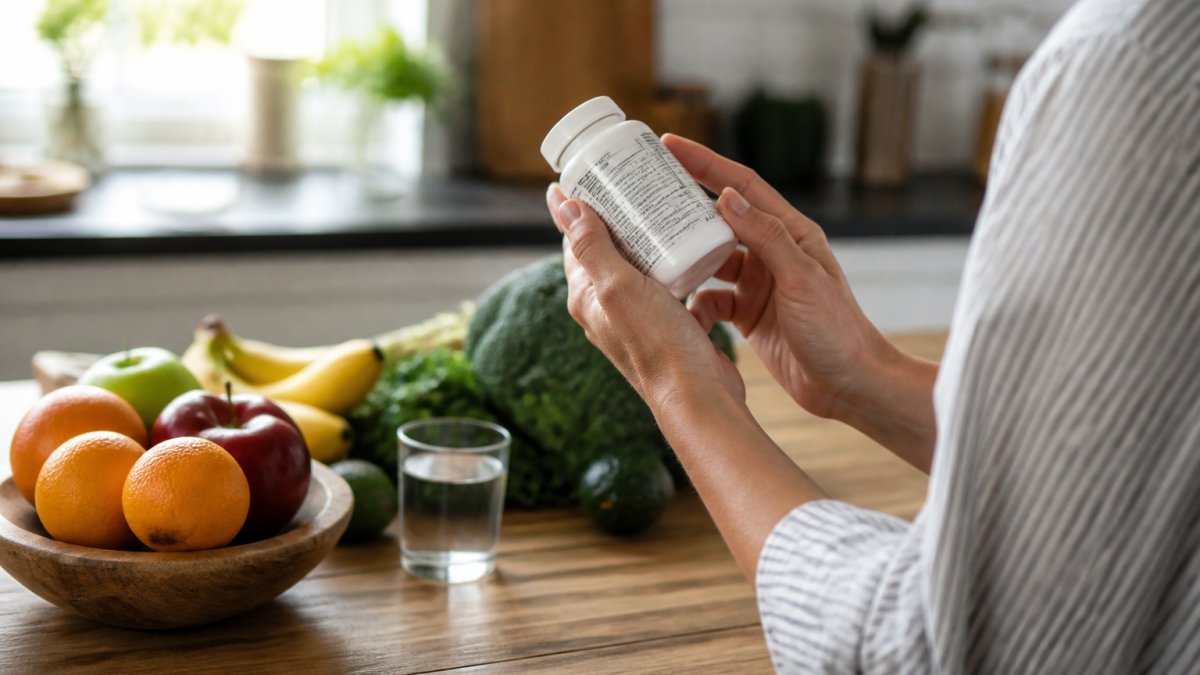
Work through this checklist before you buy:
- Format: capsules, softgels, or gummies. Pick the one you will not skip.
- Third-party seal: look for USP, NSF, or ConsumerLab verification
- Dose reality: check whether the label shows 100% or more of key nutrients
Daily Vitamin Safety and Side Effects You Should Know
Most daily vitamins are safe at label doses. Risks show up with high doses, stacking products, and certain medications, excessive fat-soluble vitamin intake is the most common problem.
Combining a multivitamin with a separate high-dose vitamin D or A supplement can push you past the safe upper limit. More is not better here.
The main risk categories:
- Fat-soluble vitamins (A, D, E, K) build up in the body and can reach toxic levels
- Iron can cause constipation and is dangerous in excess
- Calcium in very high doses is linked to kidney stones
Talk to your doctor first if you take prescription medication, are pregnant, have kidney disease, or have a digestive condition that affects absorption.
Matching Natural Daily Vitamins to Your Age, Diet, and Health Status
The right daily vitamin depends on your age, diet, and bloodwork. Generic formulas suit generic people, most of us are not.
A decision guide, by group:
- Vegans and vegetarians: prioritize B12, iron, and omega-3s
- Adults 50+: focus on B12, vitamin D, and calcium
- Pregnant or trying to conceive: folic acid is the priority
A Practical Decision Path
Before you buy, walk through these questions in order.
- Do you eat a varied diet most days? If yes, a basic multivitamin is a backup, not a necessity. If no, identify which food groups are missing before choosing a product.
- Are you in a life stage with higher needs? Pregnancy, breastfeeding, and older adulthood change nutrient requirements. Folic acid before and during pregnancy and B12 for adults over 50 are the clearest examples.
- Do you follow a restricted diet? Vegan, vegetarian, low-carb, and elimination diets each create predictable gaps. B12 for vegans and iron for some vegetarians are the common ones.
- Do you have a health condition that affects absorption? Digestive conditions such as celiac disease, Crohn's disease, and bariatric surgery can change how nutrients are absorbed. These are conversations for a clinician, not a label.
- Are you taking prescription medications? This is the question most shoppers skip. See the interaction notes below.
If you answer "yes" to questions 2 through 5, a blood test and a conversation with your doctor are more useful than a new bottle.
How to Interpret Blood Tests Without Overreading Them
A test showing low B12 confirms a deficiency; "low normal" does not always mean you need a supplement. Lab ranges are population-based, and your number needs context.
A few practical points:
- Symptoms alone are not diagnostic. Fatigue, brain fog, and hair changes have many causes. A test is what separates a guess from a finding.
- Ask what the number means for you. A result near the bottom of the range may be fine for one person and worth investigating for another, depending on diet, medications, and symptoms.
- Retest after changes. If you start a supplement for a confirmed deficiency, ask your doctor when to recheck rather than assuming the first bottle fixed it.
Medication Interactions Worth Knowing
Most daily vitamins are safe at label doses, but some nutrients interact with common prescriptions:
- Vitamin K can interfere with blood thinners such as warfarin. Consistency matters more than avoidance, talk to your clinician before changing intake.
- Calcium and iron can reduce absorption of some antibiotics and thyroid medications. Spacing doses is often the fix, but the timing should come from your pharmacist.
- Potassium supplements can be risky for people with kidney disease or those taking certain blood pressure medications.
Bring the actual bottle to the appointment, "a multivitamin" tells them nothing, but the label shows the forms and doses to check against your medication list.
Building Your Daily Vitamin Routine with Fresh Earth Wellness
A routine beats a bottle. Take your vitamin with a meal containing some fat, keep it in the same spot every morning, and set a phone reminder for the first two weeks.
If you are starting from scratch and want to buy natural vitamins online without guesswork, our guide to buying natural vitamins online walks through what to check before you order. Budget-conscious shoppers can start with our affordable natural supplement shopping tips.
Fresh Earth Wellness provides a carefully chosen array of health and wellness products, from vitamins to skincare.
Frequently Asked Questions
Are natural vitamins better than synthetic vitamins?
Natural and synthetic versions of most vitamins are chemically similar, and the body absorbs them in much the same way. What differs is often the form, the added ingredients, and the price. Check the label for the form of each vitamin and the amount per serving before deciding.
Can taking natural daily vitamins every day cause side effects?
Most people tolerate a standard multivitamin well, but high doses of certain nutrients can cause problems. Too much vitamin A, for example, can cause headaches and liver stress, and excess iron can upset the stomach. Fat-soluble vitamins like A, D, E, and K build up in the body, so more is not better. Stick to the recommended intake on the label, and speak to a pharmacist or doctor if you take prescription medication, since some vitamins interact with drugs.
Can you get enough vitamins from food without supplements?
A balanced diet built on nutrient-dense foods covers most people's needs, and food should remain the foundation. If you eat a varied diet and feel well, a daily multivitamin is optional rather than essential.
How do you choose a safe, high-quality daily vitamin?
Look for a product that lists every nutrient and its amount per serving, and consider whether the listed form suits your needs. Avoid mega-dose formulas unless a doctor recommends them. If you have a confirmed deficiency, ask your doctor about an appropriate dose.
The challenge is not finding a vitamin. It is finding the right one for your age, your diet, and your actual lab results, then taking it consistently for months rather than days. Fresh Earth Wellness makes that simpler with a curated range, clear product details, and human support when you have a question. Get started with Fresh Earth Wellness and build a daily routine you can actually keep.