 how-to
How to Identify High Quality Skincare Brands That Deliver Real Results
Last Updated: November 2, 2026
Quick Summary
Identifying high quality skincare means checking ingredient transparency, published evidence, and manufacturing standards instead of trusting front-of-pack claims. A high quality skincare brand names its actives and concentrations, publishes its full ingredient list, and can answer direct questions about sourcing and quality control. Score each brand on transparency, clinical evidence, and claim discipline before you buy.
- Define your skin type by washing your face and waiting an hour before checking how it feels.
- Ingredients are listed by weight until the one percent mark, so scan the first five.
- Patch test new products on your inner forearm for 24 to 48 hours first.
- A 30 ml serum used twice daily at 0.5 ml lasts about 30 days.
- Nearly half of 633 skincare brands lacked independently verifiable evidence for high-impact claims.
Table of Contents
- Why High Quality Skincare Brands Are Worth Finding
- Start With Your Skin Type, Concerns, and Needs
- How to Evaluate Skincare Ingredients Before You Buy
- How to Read Skincare Labels Without Getting Fooled
- Your Skincare Product Quality Checklist
- What Evidence-Based Skincare Products Actually Look Like
- Sensitive Skin, Patch Testing, and Irritation Risks
- Value, Cost Per Use, and Choosing a Brand for Your Budget
- Frequently Asked Questions
Why High Quality Skincare Brands Are Worth Finding
The global beauty market is expected to grow by 5% annually through 2030, according to McKinsey & Company's State of the Beauty Industry. More brands, more claims, more noise. At Fresh Earth Wellness, we see the same question from customers every week: how do you tell a genuinely good formula from clever packaging? Identifying high quality skincare brands is the skill that separates a routine that works from a shelf of expensive regrets. Below, we break down exactly how to evaluate ingredients, labels, evidence, and value so you can choose with confidence.
Start With Your Skin Type, Concerns, and Needs
A high quality skincare product is one that suits your skin, not the average customer's. Before comparing brands, define three things: your skin type, your main concerns, and your daily routine capacity.
How to Pin Down Your Skin Type
Wash your face, wait an hour without applying anything, then check how it feels. Tight and flaky points to dry skin. Shiny across the forehead and nose suggests oily. Both zones at once means combination. If your skin stings or reddens easily, treat it as sensitive until proven otherwise. You can also browse gentle cleansers for sensitive skin to match your skin type.
Matching Products to Skin Concerns
Match actives to the concern, not to the marketing. Dryness calls for ceramides and hyaluronic acid. Breakouts point to salicylic acid. Dullness responds to vitamin C or gentle exfoliants. This is how you compare products without getting lost in claims.
| Skin Concern | Ingredient to Look For | Where It Fits |
|---|---|---|
| Dryness | Ceramides, glycerin | Moisturizer |
| Breakouts | Salicylic acid | Cleanser or serum |
| Dullness | Vitamin C, glycolic acid | Morning serum |
| Sensitivity | Fragrance-free formulas | Everything |
How to Evaluate Skincare Ingredients Before You Buy
Learning how to evaluate skincare ingredients comes down to three questions: what is the active, at what strength, and what supports it? A formula with a proven active at a sensible concentration, buffered by soothing and hydrating ingredients, usually outperforms a longer list of trendy extracts.
Active Ingredients and Product Formulation
The active ingredient does the work; the formulation decides whether your skin tolerates it. A well-built product pairs the active with humectants and barrier-supporting ingredients to reduce dryness. For a real example, see this glycolic acid exfoliating toner. Watch out: a strong acid in a poorly buffered base can irritate even resilient skin.
How to Read Skincare Labels Without Getting Fooled
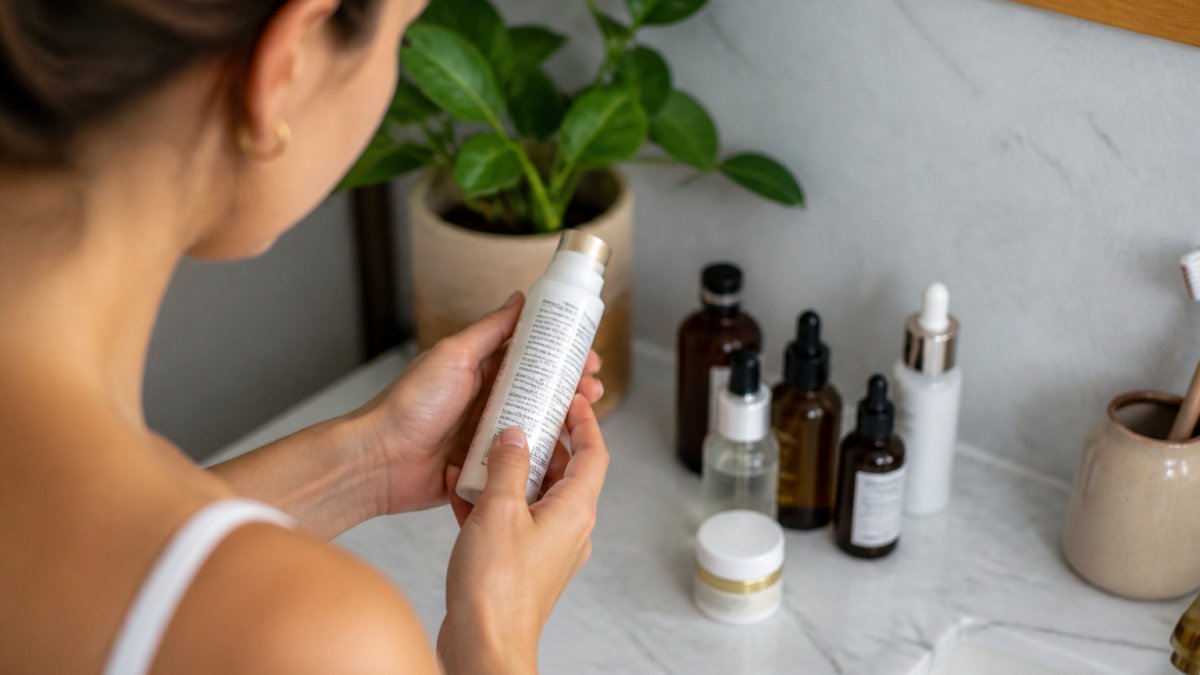
How to read skincare labels is simpler than brands want you to think. Ingredients are listed by weight until the one percent mark, so everything after the preservative is often trace.
Your Skincare Product Quality Checklist
Use this skincare product quality checklist before committing to a full-size purchase:
- The active ingredient and its concentration are stated clearly
- The full ingredient list is published, not summarised
- The brand answers where ingredients are sourced
- Manufacturing standards or quality control processes are described
- Claims are specific and testable, not vague
- Customer support can answer a direct ingredient question
- The product suits your skin type and concern
Manufacturing, Sourcing, and Quality Control Transparency
A brand that will not tell you how its products are made is asking for blind trust. Look for named manufacturing standards, batch or lot codes, and clear sourcing information on any brand you consider. These details separate serious operations from resellers.
What Evidence-Based Skincare Products Actually Look Like
Evidence-based skincare products make claims you can check. A Walden University qualitative study on skincare brand loyalty explored how brand leaders build loyalty, and the takeaway is blunt: trust is earned through consistency and transparency, not slogans. A Beauty Independent report on unverified skincare claims found that nearly half of 633 skincare brands lacked independently verifiable evidence for high-impact claims.
How to Verify Product Claims and Clinical Evidence
Most brands use the same vocabulary, "clinically proven," "dermatologist-tested," "visibly reduces", but those phrases describe very different levels of evidence. A simple three-tier framework helps you sort them:
- Marketing language: Words like "visibly," "appears to," "helps support," or "inspired by." These are not claims you can test. They are impressions. Treat them as packaging, not proof.
- Consumer perception testing: Brands survey users ("92% agreed skin felt smoother"). This is real data, but it measures how people felt, not what changed in the skin. Sample sizes are often small, and results are self-reported. Useful for tolerability and user experience, weak for efficacy.
- Peer-reviewed or controlled clinical evidence: A study with a defined protocol, a control or comparator group, instrumental measurements (corneometry, TEWL, chromametry), and publication in a journal or a publicly available report. This is the only tier that supports a strong efficacy claim.
When a brand says "clinically proven," ask three questions. Was the study on the finished product or only the raw ingredient? How many people took part, and for how long? Was it independent, or run by the brand's own lab? A brand that will not publish or summarize the study is telling you nothing you can verify. Prestige and popularity alone are not measures of quality; earned media value, like the $650.6 million CeraVe generated in the 12 months to May 2026 per WWD's 2026 beauty brand ranking, measures buzz, not formulation.
A Repeatable Brand Evaluation Checklist
Use this scoring framework to compare brands on substance rather than reputation. Score each item 0 (absent), 1 (partial), or 2 (clear and verifiable):
- Ingredient transparency: Full INCI list published, actives named with concentrations where relevant, no hidden fragrance or dye blends.
- Clinical evidence: At least one finished-product study summarized with sample size, duration, and outcome measures, or honest language that avoids implying proof.
- Manufacturing and quality control: Named manufacturing standards (GMP, ISO), batch or lot codes on packaging, and a stated stability or preservative testing process.
- Sourcing transparency: Where key ingredients come from, and whether the brand can answer a direct sourcing question.
- Claim discipline: Claims are specific, bounded, and consistent across the website, packaging, and customer service.
- Safety and tolerability: Allergen disclosure, fragrance policy, and clear guidance on patch testing and when to stop use.
A brand that cannot answer basic questions about items 1-3 is asking for blind trust. This checklist is the difference between evaluating a brand and being persuaded by one.
Sensitive Skin, Patch Testing, and Irritation Risks
Sensitive skin deserves a slow approach. Patch test every new product on your inner forearm for 24 to 48 hours before it touches your face. Introduce one new product at a time, and wait two weeks before adding another.
If your skin is reactive, take extra care before you buy anything new. For a deeper look at options, see this guide to organic skincare for sensitive skin. Stop using any product that causes burning, swelling, or a spreading rash, and speak to a pharmacist or doctor if it persists.
Value, Cost Per Use, and Choosing a Brand for Your Budget
Value is not the same as a low price. The sticker price tells you what you pay today; cost per use tells you what the product actually costs across its life. Divide the price by the number of uses you realistically get, then weigh that against how well the product performs and how much of it you need per application.
How to Calculate Cost Per Use
Start with the package size and the amount you use each time. A 30 ml serum used twice daily at roughly 0.5 ml per application lasts about 30 days. Divide the price of any product by the number of days it lasts to find its cost per day of use. The cheaper product is not automatically the better value, but the expensive one is not automatically the worse value either. The number that matters is cost per day of actual use, not cost per bottle.
Three variables change that math more than the price tag:
- Concentration: A 10% vitamin C serum may need less product per application than a 5% formula to deliver the same result, which can narrow the cost-per-use gap between a budget and a premium option.
- Packaging: Airless pumps and opaque tubes protect actives and reduce waste; open jars and droppers can degrade formulas faster and lead to replacing them sooner.
- Routine fit: A single well-formulated product that replaces two or three failed experiments often costs less per month than a shelf of bargain products that never quite work.
Comparing Brands Beyond the Sticker Price
When you compare two brands, line up four numbers side by side: price, size, estimated uses, and cost per use. Then ask whether the formulation justifies the difference. You can browse the Kiehl's product range as an example of a trusted brand to compare.
Watch out: cost-per-use comparisons break down if you cannot estimate how much you actually use. Measure your current products for a week before you compare, most people use more serum and less moisturizer than they assume.
Best for: shoppers who want one reliable product instead of five experiments. Skip if: you enjoy rotating trends and do not mind replacing products often.
For our own curated selection, shop the Fresh Earth Wellness range and check current pricing directly on the website.
Frequently Asked Questions
How can you tell if a skincare brand is high quality?
Look beyond the marketing. A high quality skincare brand publishes full ingredient lists, explains how its formulations were tested, and makes claims you can verify. Check whether the brand names its manufacturing standards and quality control process. Treat vague promises with caution. Also confirm the product suits your skin type and that the brand offers clear support if something goes wrong.
Are expensive skincare brands better quality?
Price does not guarantee quality. A science-led selection framework argues that prestige and popularity alone are not sufficient measures of skincare quality; what matters is the evidence behind the formulation and clear information about what is inside. Compare products by ingredient list, clinical evidence, and cost per use rather than the price tag. Some affordable brands publish more testing detail than luxury ones. Judge each brand on transparency and results, not on how much it costs.
How do you choose skincare products for sensitive skin?
Start with a short ingredient list and avoid known irritants. Patch test any new product on a small area of skin for 24 to 48 hours before applying it widely. Look for brands that state their products are dermatologist tested and describe how they handle sensitive skin risks. Keep your routine simple with a gentle cleanser, moisturizer, and sunscreen, then add one new product at a time so you can identify what causes a reaction. Stop using anything that stings or causes redness.
What does third-party testing mean for skincare products?
Third-party testing means an independent lab, not the brand itself, checks a product for safety, stability, or the presence of specific ingredients. It adds credibility because the results do not depend on the brand's own claims. When evaluating a skincare brand, look for a clear statement about who tested the product and what was measured. Not every brand commissions this testing, so ask directly or check the brand's website for details before you buy.
Finding skincare you can trust takes more than a good label. Fresh Earth Wellness stocks a carefully chosen range of health and wellness products, with clear ingredient information, reliable support from real people, and a fast, user-friendly shopping experience. Get started with Fresh Earth Wellness and build a routine you can actually verify.