
 Ultimate guide
What a Supplement Certificate of Analysis Really Tells You
Last Updated: November 21, 2026
Quick Summary
A supplement certificate of analysis is a lot-specific document reporting laboratory test results for a batch of a dietary supplement, including what was tested, the method, the specification, and pass or fail. Treat it as one piece of evidence, not a guarantee, since it lists what was tested, never what was skipped.
- Match the lot number on the COA to the number printed on your bottle or carton.
- Read the specification column before results, because a potency number means nothing without its range.
- A COA reporting only Pass with no numeric result, units, or method gives you nothing to verify.
- Confirm the issuing laboratory exists and will confirm it issued that report for that lot.
- A COA cannot prove a supplement is effective, well-formulated, or worth its place in your routine.
Table of Contents
- What a Supplement Certificate of Analysis Actually Is
- How to Read a Supplement COA Step by Step
- What a Supplement COA Example Looks Like
- Why a COA for Vitamins Is Different from a COA for Herbal Blends
- Supplement COA Red Flags That Should Stop a Purchase
- How to Verify a COA's Authenticity and Compare Batches
- What a COA Cannot Prove and How to Act on That
- Checking COAs Before You Buy at Fresh Earth Wellness
- Frequently Asked Questions
What a Supplement Certificate of Analysis Actually Is
A supplement certificate of analysis is a lot-specific document that reports the results of laboratory testing performed on a batch of a dietary supplement. It records what was tested, the analytical method used, the specification, and whether the sample passed or failed. It is best treated as one piece of evidence, not a guarantee.
A certificate of analysis (COA) is only as trustworthy as the laboratory that produced it and the sampling behind it. A COA does not, by itself, establish that a supplement is trustworthy or that its testing was adequate.
That distinction matters when you are deciding what to buy.
What a COA Contains (and What It Leaves Out)
A complete COA typically carries these elements:
- Product and lot identification - product name, lot or batch number, manufacture and expiry dates
- Test list - identity, potency or assay, purity, and contaminant screens
- Specification and acceptance criteria - the limit each result is measured against
- Test method - the analytical technique used for each test
- Results and units - the measured value with units of measurement
- Pass/fail determination - the batch release decision
- Laboratory identity and accreditation - who ran the test and under what quality system
What it leaves out is just as important: the sampling plan, the detection limits when not stated, and any test that was never run. A COA lists what was tested, never what was skipped.
How to Read a Supplement COA Step by Step
Reading a supplement COA takes about five minutes once you know the order of operations. Work through it systematically rather than scanning for a green checkmark.
- Match the lot number. Confirm the lot or batch number on the COA matches the number printed on your bottle or carton. A COA for a different batch tells you nothing about yours.
- Check the dates. Compare the manufacture and expiry dates on the document with the label. A COA attached to an expired batch is a red flag.
- Read the specification column first. Before looking at results, find the acceptance criteria. A potency result means nothing without the range it is measured against.
- Compare result to specification. Note the units of measurement and whether the value sits inside the reference range.
- Identify the test methods. Look for the analytical technique named for each test. A method named in full is a good sign; a blank cell is not.
- Check who tested it. Look for a named third-party laboratory and accreditation details.
- Look for missing tests. For a botanical blend, expect identity, potency, heavy metals, microbiological testing, and pesticide residues. Absence is information.
A Glossary of COA Terms You Will See
- Lot number / batch: the specific production run the document describes.
- Assay: the quantitative measurement of a marker compound's strength.
- Identity testing: confirms the raw material is what the label claims.
- Acceptance criteria: the limit a result must meet to pass.
- Detection limit: the lowest amount a method can reliably detect.
- Residual solvents: chemical residues left from processing.
- Specification: the written standard the batch is measured against.
Reading a COA is a short, ordered routine rather than a hunt for a green checkmark.
| Step | What to do |
|---|---|
| 1 | Match the lot number on the COA to your bottle |
| 2 | Check manufacture and expiry dates against the label |
| 3 | Read the specification column before the results |
| 4 | Compare result to specification, noting units |
| 5 | Identify the test methods named for each test |
| 6 | Check who tested it and accreditation details |
| 7 | Look for missing tests, such as heavy metals |
What a Supplement COA Example Looks Like
Picture a real document. A header names the finished product and the lot number.
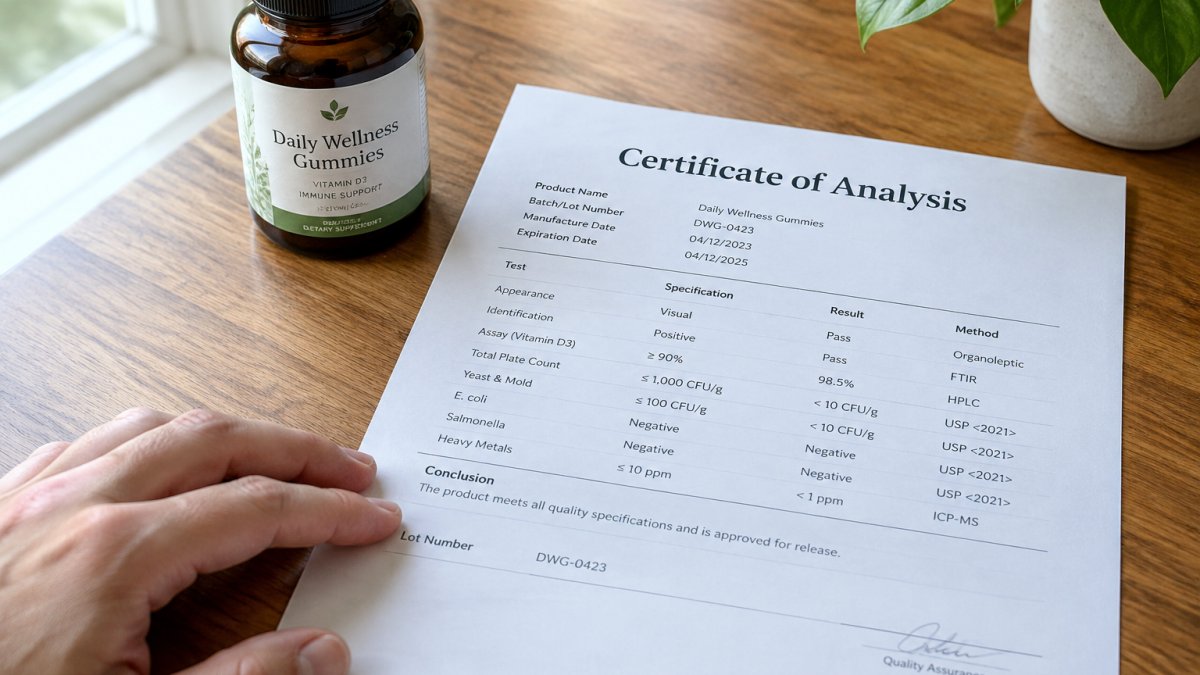
An annotated sample COA is where most guides stop short, and where readers learn fastest.
Here is how a realistic finished-product COA for a botanical capsule reads, field by field.
The results table is the heart of the document.
Notice what those rows teach. The specification column gives the result meaning: 3.1 mg is only good news because the standard was 2.5 mg or more.
Watch out: a COA that reports only "Pass" with no numeric result, no units, and no method gives you nothing to verify.
A second useful exercise: compare two COAs for the same product from different lots. Test list, methods, and specifications should stay stable; only results and lot identifiers should move. If the panel shrinks from five tests to two between batches, that change is the story, not the green checkmarks.
Finally, keep the sampling question in view. The COA describes the sample the lab received, not every capsule in the batch.
Why a COA for Vitamins Is Different from a COA for Herbal Blends
Single-ingredient vitamins often have a defined chemical identity, so assay and potency results are straightforward to report. Herbal blends are messier: a botanical extract contains many compounds, so a lab must choose a marker compound for identity and potency, and that choice shapes everything the COA can show.
That is why a COA for vitamins often reads as a short, tidy table while a COA for an herbal product runs longer with more caveats. To see how label dates and batch details line up on a real product, our guide to checking supplement expiration dates on any label walks through it. For the herbal category, the organic ashwagandha capsules we carry show what a botanical product looks like on the shelf, and our article on the benefits of vitamin D supplements for adults covers the single-ingredient side.
Supplement COA Red Flags That Should Stop a Purchase
Certain warning signs should end the conversation. A COA with no lot number, or one whose lot number does not match the product, is not batch-specific and tells you nothing about what you are holding. Results with no specification column give you nothing to judge against. Missing laboratory identity, missing test methods, and a suspiciously short test list on a complex botanical blend all deserve scrutiny.
How to Verify a COA's Authenticity and Compare Batches
Verification starts with the source. Ask where the COA came from: a laboratory's own portal, a QR code on the package, or a PDF emailed on request.
Tracing the source is only the first step. A practical verification pass has four checks, each catching a different failure mode.
Watch out: a QR code that resolves to a generic marketing page rather than a lot-specific report is not verification.
Comparing batches is the practical test. Pull two COAs for the same product from different lots and check whether the test list, methods, and specifications stay consistent.
If a COA fails any of these checks, do not argue with the document, ask the seller for a lot-specific report from a named laboratory. For readers weighing whether a product deserves a place in the routine at all, our article on whether natural daily vitamins are worth taking is the right next read.
What a COA Cannot Prove and How to Act on That
A COA cannot prove a supplement is effective, well-formulated, or worth its place in your routine. It reports on a sample from a batch, not every bottle, and says nothing about whether the ingredients suit your needs. It also cannot confirm the sampling was representative, which is why detection limits and sampling plans matter.
When a COA is missing or thin, ask the retailer directly for lot-specific documentation before buying. If you are weighing whether a daily product earns its place at all, our article on whether natural daily vitamins are worth taking is the right next read.
Checking COAs Before You Buy at Fresh Earth Wellness
Shoppers reasonably want to know that the product in the cart is the product described. Fresh Earth Wellness offers a fast, user-friendly online shopping experience and customer-service-oriented support.
Fresh Earth Wellness offers a carefully chosen range of health and wellness products, from vitamins to skincare. Browse the category you need, check the product details, and contact us with any questions before you order.
The gap between a document that looks official and one that actually tells you something is where most supplement purchases go wrong. Fresh Earth Wellness stocks a carefully chosen range of vitamins, herbal products, and skincare, backs it with responsive customer support, and keeps the shopping experience simple from browse to delivery.
Frequently Asked Questions
What is the purpose of a Certificate of Analysis?
A supplement certificate of analysis documents what a specific lot was tested for and what the results were. It records the lot number, the tests run, the methods used, the acceptance criteria and the pass or fail outcome. Its purpose is traceability and batch release: it lets a buyer or retailer confirm that a defined batch met a defined specification before it was released for sale. It is not a safety certificate or a proof of effectiveness, and a COA does not replace regulatory compliance or GMP oversight.
Does a COA prove that a supplement is safe or effective?
No. A COA shows that selected tests were run on a sample from a lot and that the results met a stated specification. It does not prove the product works for its intended purpose, and it does not guarantee safety for every person. ConsumerLab has warned that manufacturer-provided lab reports and COAs can involve incorrect testing or dry labbing, and a 2026 article argued that a COA may fail to catch supplement fraud. Treat a COA as one piece of evidence, not a final verdict.
How do you read a supplement COA?
Start with the product name, lot number and manufacture or expiry dates to confirm the document matches the bottle in your hand. Then read each test line: what was tested, the laboratory method, the specification or acceptance criteria, the result with units, and the pass or fail outcome. Check that the testing laboratory is named and accredited. Finally, look at what is missing: if heavy metals, microbiological testing or identity testing are absent, the COA is incomplete for a dietary supplement.
What should a supplement Certificate of Analysis include?
A complete COA should include the product and raw material name, the lot or batch number, the testing laboratory and its accreditation, the test methods, the specification and acceptance criteria, the measured result with units of measurement, the pass or fail status, and the date of testing and release. For a dietary supplement, expect identity testing, potency or assay, purity checks such as heavy metals, microbiological testing, and where relevant pesticide residues and residual solvents.
Can I see a COA example for vitamins?
Yes. A typical COA for vitamins lists the vitamin name and form, the label claim, the assay result as a percentage of claim, and tests for heavy metals and microbiological contamination. For example, a vitamin D3 lot might show an assay result within the specification range, a heavy metals result below the detection limit, and a microbiological result reported as absent. The example section of this guide walks through how to read each line and what a weak COA looks like by comparison.
What are common supplement COA red flags?
Watch for a COA with no lot number, a lot number that does not match the bottle, no named testing laboratory, no accreditation, missing test methods, results reported without units, and a pass column that is ticked for every line with no raw data. Other red flags include a COA that covers only potency and skips heavy metals or microbiological testing, and a document that looks like a template with the product name changed. Any of these should prompt you to ask the retailer for a lot-specific report.