 how-to
How to Spot Fake Health Products: A 2026 Guide
Table of Contents
- Why Spotting Fake Health Products Matters
- How to Tell if Supplements Are Fake: Visual Inspection Basics
- Recognizing Health Product Scams and Suspicious Claims
- How to Check if an Online Pharmacy Is Legitimate
- Supplement Safety Checklist: Step-by-Step Verification
- What to Do If You Suspect You've Bought a Counterfeit Product
- Frequently Asked Questions
Last Updated: October 21, 2026
Why Spotting Fake Health Products Matters
Counterfeit health products are a real problem (the WHO). They can contain hidden ingredients, dangerous contaminants, or no active ingredients at all.
The stakes are high. A counterfeit product might look identical to the real thing. But appearances can deceive. Some fakes contain harmful substances.
Learning to spot fake health products protects you and your family. It's a skill worth developing if you buy vitamins, supplements, or medications online.
How to Tell if Supplements Are Fake: Visual Inspection Basics
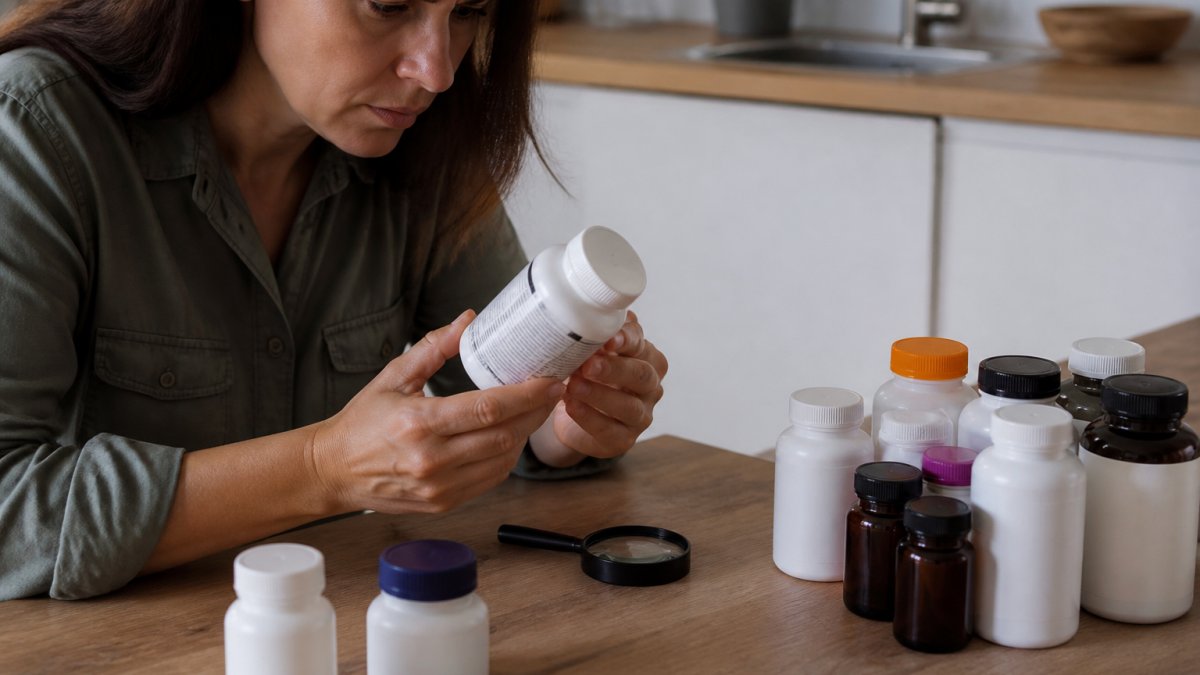
Visual inspection is a useful first filter, not a verdict. Counterfeits can be convincing enough to fool a pharmacist at a glance, so treat what follows as a way to decide whether to keep investigating, not as proof of authenticity.

Start with the packaging and label
Legitimate manufacturers invest in print quality and consistency. Look for:
- Sharp, consistent printing. Blurry text, misaligned colors, or a label that looks photocopied are warning signs.
- Correct spelling and grammar. Typos in the brand name, ingredient names, or dosage instructions are a classic counterfeit tell.
- Consistent fonts and layout. Professional packaging uses the same typeface and spacing throughout.
Check seals and tamper evidence
- Intact tamper-evident seals. A broken, missing, or re-glued seal is a stop sign.
- Shrink wrap that looks resealed. Wrinkled or uneven outer wrap can indicate repackaging.
- Security features that match the brand. Many manufacturers use holograms, color-shifting ink, or embossed marks. Compare against the brand's own published guidance rather than assuming a feature is genuine because it exists.
Examine the product itself, by product type
Different product types fail in different ways. Use the checks that fit what you bought.
Tablets and capsules
- Color and markings. Compare against a known-good sample or the manufacturer's published images. Uneven color, faded imprint codes, or missing score lines are suspicious.
- Shape and size consistency. Pills in the same bottle should be uniform. Mixed sizes or shapes suggest a blended or repackaged batch.
- Texture and surface. Chalky, sticky, or unusually rough surfaces warrant a closer look. A strong chemical or vinegar-like smell where none is expected is a warning sign.
Liquids, creams, and inhalers
- Color, clarity, and consistency. Separation, unusual cloudiness, or a changed texture compared with a previous purchase is a reason to pause.
- Smell and feel. A different odor or a gritty cream where it was previously smooth is worth investigating.
- Device integrity. For inhalers and droppers, check that the mechanism works smoothly and that the dose counter (if present) behaves as expected.
Supplements
- Supplement Facts panel present and complete. Missing or obviously altered panels are a red flag.
- Ingredient amounts stated in units, not just names. "Proprietary blend" with no amounts makes it impossible to judge what you are taking.
- Serving size and servings per container that add up. Inconsistent numbers suggest a relabeled product.
Compare against a known-good reference
If you have bought the same product before, compare side by side: label layout, font, lot-number format, seal style, pill markings, and packaging weight. Any meaningful difference is a reason to verify further. If you have not bought it before, compare against the manufacturer's own product images and label information rather than against marketplace photos.
Know what visual inspection cannot tell you
Visual checks cannot detect:
- Active ingredient content. A perfectly printed tablet can contain the wrong dose or no active ingredient.
- Contaminants. Heavy metals, undeclared pharmaceuticals, or microbial contamination are invisible.
- Whether the lot number is real. A convincing fake can carry a plausible-looking lot code.
That is why the next steps matter: verify the seller, check the lot and expiry details against the manufacturer where possible, and use official reporting and safety resources when something does not add up. If you are unsure, ask a pharmacist to look at the product before you take it.
Recognizing Health Product Scams and Suspicious Claims
Scammers use misleading health claims to sell fake products. Learn to recognize these red flags.
Be skeptical of miracle cures. Real health products support wellness. They don't promise instant results or cure serious diseases. Watch for these suspicious claims:
- "Cures" serious diseases, Legitimate supplements can't cure cancer, diabetes, or heart disease. If a product claims it can, it's a scam.
- Quick weight loss promises, Sustainable weight loss takes time. Claims of losing 20 pounds in 2 weeks are false.
- "Miracle" or "breakthrough" language, Real science uses measured language. Hype is a warning sign.
Check whether claims are supported by scientific evidence. Real supplements have research behind them. Fake products rely on emotional appeals and testimonials.
Be wary of products that pressure you to buy immediately. Scammers create artificial urgency. Legitimate retailers don't rush you. Real companies are confident their products speak for themselves.
How to Check if an Online Pharmacy Is Legitimate
Buying medicines online requires extra caution. Not all online pharmacies are trustworthy. Verify the pharmacy before you buy.
Verifying Seller Credentials and Licensing
Start by checking licensing. Legitimate pharmacies are licensed and regulated. Here's how to verify:
- Look for licensing information, Real pharmacies display their license number prominently on their website.
- Check the pharmacy's registration, Many countries maintain registries of licensed pharmacies. Search the registry for the pharmacy name.
- Verify the pharmacist on duty, Licensed pharmacies list a licensed pharmacist available to answer questions. Contact them if you have concerns.
Contact the pharmacy directly. Call their customer service number. Real pharmacies have real people available to help. If you can't reach anyone, that's a red flag.
Research the company online. Check reviews on independent review sites. Look for complaints about counterfeit products or missing orders. Real companies have mostly positive feedback.
Assessing Price and Availability
Price matters, but unusually low prices are suspicious. If a prescription medication costs significantly less than everywhere else, ask why.
Legitimate pharmacies price competitively but realistically. Scammers use rock-bottom prices to lure customers. Then they send counterfeit products.
Be cautious if a pharmacy:
- Offers prices far below market rates
- Sells prescription medicines without a valid prescription
- Doesn't require a doctor's prescription for prescription-only drugs
Real pharmacies maintain realistic pricing and follow legal requirements. They require prescriptions for prescription medications. They don't promise overnight shipping for items that take time to source.
Supplement Safety Checklist: Step-by-Step Verification
Use this checklist before buying any health product online or in stores. Work through each step to verify authenticity.
| Step | What to Check | Red Flag |
|---|---|---|
| 1. Packaging | Sharp printing, consistent colors, professional appearance | Blurry text, faded colors, peeling labels |
| 2. Labels | Complete ingredient list, dosage, warnings, manufacturer details | Missing information, vague descriptions, typos |
| 3. Seals | Intact tamper-evident seals and security features | Broken seals, missing seals, damaged packaging |
| 4. Physical Product | Consistent color, shape, size, and texture | Uneven appearance, rough texture, discoloration |
| 5. Seller | Licensed, established company with real customer service | No licensing info, unreachable support, poor reviews |
| 6. Price | Realistic and competitive pricing | Suspiciously low prices, too good to be true |
| 7. Claims | Measured language backed by evidence | Miracle claims, hype, testimonials only |
| 8. Lot Number | Clearly printed, matches manufacturer records | Missing or illegible lot numbers |
Before checkout, verify the seller's legitimacy. Check their contact information. Look for a physical address and phone number. Real companies have verifiable locations.
Review the product one more time. Does everything look right? Trust your instincts. If something feels off, don't buy.
What to Do If You Suspect You've Bought a Counterfeit Product
Acting quickly protects you and helps keep the product out of other people's hands. Work through these steps in order.
1. Stop using the product, carefully
- Stop taking or applying it unless a clinician has told you otherwise. Do not double up on a replacement dose to "catch up."
- Set it aside safely, out of reach of children and pets, and away from food.
- Do not throw it away yet. You may need it as evidence.
2. Preserve the evidence
Keep and photograph:
- The product and all packaging, including the outer box, bottle, blister pack, and any seals.
- The label and lot/expiry details, photographed clearly and in focus.
- Receipts and order confirmations, including the seller's name, website, and order number.
Store the product in a sealed bag or container and label it clearly as suspected counterfeit.
3. Contact the seller and the manufacturer
- Notify the retailer in writing and ask for a refund or replacement. Include photos and your order details.
- Contact the legitimate manufacturer through the contact details on their official website. They can often confirm whether a lot number is genuine and may want the product for investigation. Do not rely on contact details printed only on the suspect packaging.
4. Talk to a pharmacist or clinician
A pharmacist can help you judge the immediate risk, advise on whether you need a replacement dose or a different product, and tell you what symptoms to watch for. If you have already taken the product, tell your clinician the product name, the dose, and the dates you used it, and bring the packaging if you still have it.
5. Report the product
Reporting is what turns a personal bad purchase into protection for others. Depending on where you are:
- Report to your national medicines or health-products regulator. In the United States, the FDA accepts reports of suspected counterfeit or fraudulent health products; equivalent agencies exist in most countries.
- Report to your consumer protection agency for misleading claims or fraudulent sellers.
- Report to the online marketplace or platform where you bought it, using their fraud or counterfeit reporting process.
- Tell your pharmacist or clinician, who may be required or able to pass the report along.
Keep a record of where and when you reported, and any reference numbers you receive.
6. Follow up on your health
If you used the product for a condition, check with a clinician that your treatment is still appropriate. Do not assume a replacement product from an unknown seller is genuine just because the first one was refunded.
The FDA provides guidance on identifying counterfeit medicines
Frequently Asked Questions
How can you tell if supplements are fake?
Check the packaging for poor print quality, misspellings, or blurry logos. Compare the tablet color, shape, and size against official product images from the manufacturer's website. Verify the ingredient list matches the label, and inspect the expiration date and lot number for clarity. Unusually low prices, missing contact information, or suspicious sellers are additional warning signs. When in doubt, buy from licensed pharmacies or the manufacturer directly.
What warning signs suggest a health product may be counterfeit?
Watch for exaggerated health claims such as 'miracle cure' or 'guaranteed weight loss in days.' Legitimate products include scientific disclaimers and realistic timelines. Counterfeit products often have spelling errors, faded printing, or inconsistent branding. Sellers offering prices significantly below market rates, operating from unverified locations, or refusing secure payment methods are red flags. Check whether the product appears in official databases and whether the seller is licensed.
How can you check whether an online seller is legitimate?
Verify the seller's business license and pharmacy credentials through government databases or regulatory bodies. Look for a physical address, phone number, and clear return policy on their website. Read customer reviews on independent platforms, not just the seller's site. Check if they require a prescription for prescription medications. Legitimate sellers display security badges, offer secure checkout, and provide transparent contact information. Avoid sellers with no verifiable history or those operating from countries with weak product oversight.
What should you do if you think you bought a counterfeit health product?
Stop using the product immediately. Contact the seller and request a refund with photographic evidence of the suspicious packaging or labeling. Report the suspected counterfeit to your country's consumer protection agency or health regulator. If you have already consumed the product and experience adverse effects, seek medical attention and inform your doctor of the suspected counterfeit. Keep all packaging, receipts, and documentation. File a formal complaint with the regulatory body to help protect other consumers.